Cheap Gym Near Me: what to compare before you join — hours, bookings, day passes and how the floor manages busy periods. Check the opening hours first. This guide covers What to Do Before You Start, A Step-by-Step Approach and Common Mistakes and How to Avoid Them.
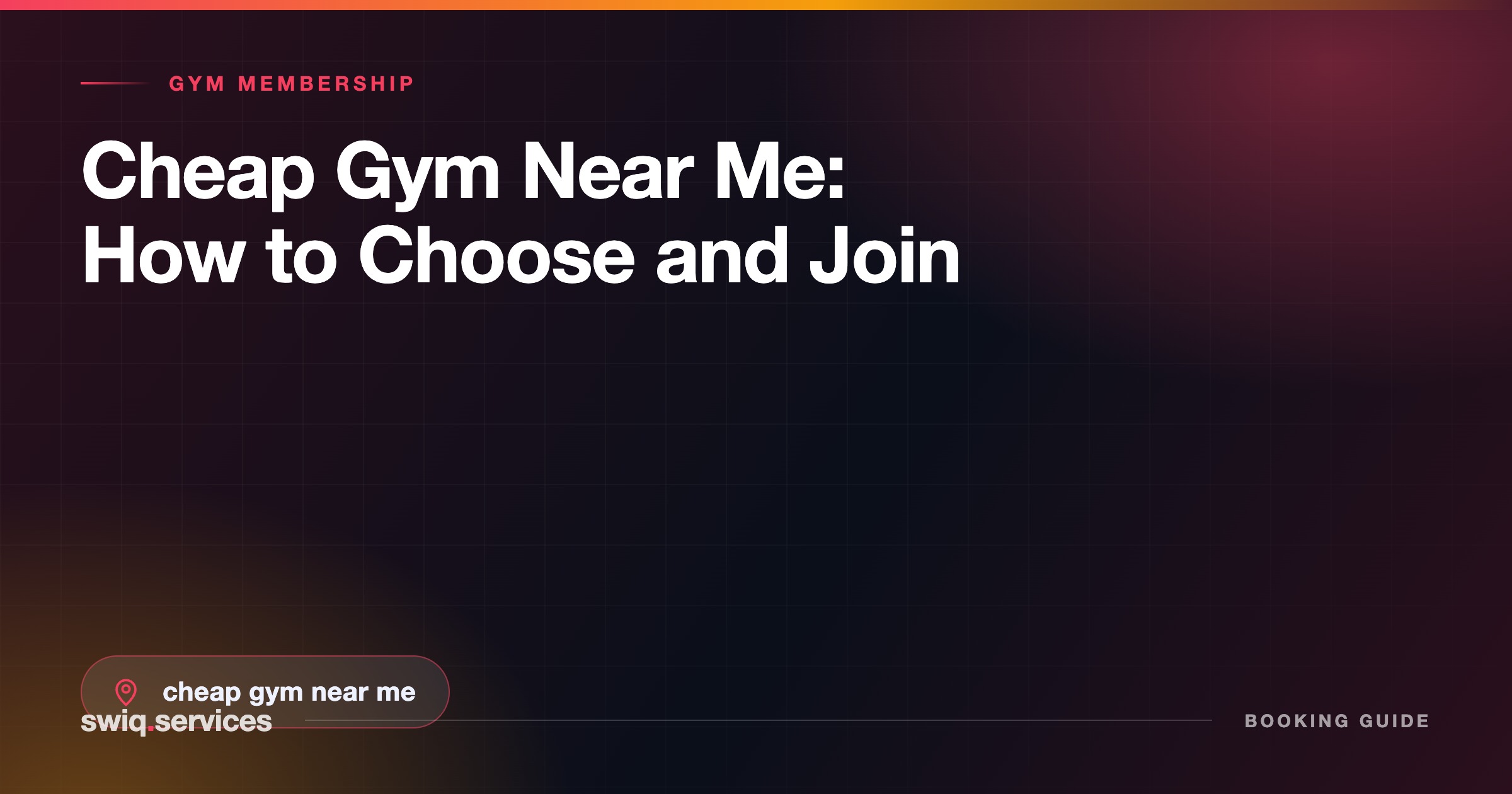
cheap gym near me — Cheap Gym Near Me: what to compare before you join — hours, bookings, day passes and how the floor manages busy periods. Check the opening hours first. This guide breaks down what actually matters when you compare memberships: staffed hours versus your real week, class booking and day-pass flows, what the contract actually says and how busy the floor gets at the hour you would train. Whether you are new to your area or switching after a lapsed membership, the detail below comes from how busy operations really run their week — fewer surprises, a sign-up you understand and a routine that survives February.
Key takeaways
- Know what you are comparing before you start — write down the two or three things that matter most.
- Use the booking channel that confirms instantly, and keep the confirmation where you can find it on the day.
- Watch the busy hours: mid-morning and late afternoon are where queues quietly grow.
- Measure the result after a few weeks — wait time, no-shows and staff load tell you whether it worked.
Understanding Cheap Gym Near Me
In your area, comparing cheap gym options on a phone gives you three signals fast: whether staffed hours match your actual day, whether the booking or day-pass flow works without a phone call, and how crowded the floor looks at the hour you would train. Gyms publish the polished version of all three, so the useful checks are the ones nobody can stage — live class availability, guest access rules and what happens to your membership when you travel.
Before you commit in your area, walk the cheap gym shortlist against your real week: the days you will actually go, the hour you will arrive, whether classes need booking ahead and what the cancellation or freeze policy says. Ask for the numbers nobody puts on the poster — peak-hour occupancy, contract length, joining fee and what is included. The membership that fits your Tuesday morning is the one you are still paying for in March.
For authoritative background, see SBA small business resources — a useful neutral reference while you weigh the options. The rest of this guide stays practical: the operational detail you can act on this week.
What to Do Before You Start
Preparation removes most of the friction before it starts. Write down your non-negotiables — the days you will actually train, the hour you will arrive and the budget you will keep paying in March — and check each candidate against them rather than against the marketing page. It takes twenty minutes and it stops you from discovering a mismatch on the day you booked.
- Check staffed hours against the hour you would actually train.
- Ask what is included: classes, guest passes, showers, parking.
- Read the freeze and cancellation terms before you sign anything.
- Visit or tour during your target hour, not at the empty midday slot.
- Compare the total monthly cost, including joining fee and contract length.
Keep the output of this step somewhere the team can see it — a one-page summary beats a memory. When the choice is finally made, the same list becomes the acceptance test: every item either passes or gets fixed, and nobody has to argue about what done meant. For related reading, see Clinic Near Me and 24 Hour Doctor Near Me.
A Step-by-Step Approach
- List the days and hours you will realistically train each week.
- Shortlist gyms whose staffed hours cover at least two of them.
- Check class booking, guest access and day-pass rules while you compare.
- Tour or trial during your target hour to see real occupancy.
- Read the contract: length, joining fee, freeze and cancellation terms.
- Compare the total monthly cost rather than the intro offer.
- Join, diarise the first week and review the membership after 30 days.
For background reading from an independent source, see WHO guidance. The sequence above is deliberately conservative: it works whether you are testing one day or rolling across locations, and it produces numbers you can defend in a weekly review.
Common Mistakes and How to Avoid Them
Most failures in this area are unglamorous: a setting nobody checked, a message nobody tested, a policy nobody wrote down. The pattern below covers what teams hit first — and the fix for each is usually cheaper than the workaround people live with.
- Joining on the intro offer without reading the contract length.
- Touring at midday, then training at six in the evening.
- Assuming classes are included when they need separate booking.
- Ignoring the freeze and cancellation terms until you need them.
- Comparing the joining fee only, not the total monthly cost.
- Signing up after one visit and never diarising the first week.
None of these are dramatic, which is why they survive contact with a busy week. Assign each one an owner this month: the cost of fixing a setting is trivial compared with the cost of living with it for a year.
How to Compare Memberships
Take your shortlist and score each gym on the same five lines: staffed hours against your week, class booking rules, guest and day-pass access, contract length and total monthly cost. Two minutes per gym, straight from the paper they hand you. The gym with the best equipment photos often loses here, and the one that publishes honest peak-hour guidance rarely does.
Then test the experience itself: visit during your target hour, watch how the front desk handles a day pass and read the freeze terms once more before signing. If any of that feels opaque now, it will feel worse in month four — and the clubs that make it simple tend to be the ones with the steadiest memberships.
- Hours that cover at least two real training slots a week.
- Class booking and guest rules written in plain language.
- Contract length, joining fee and freeze terms in writing.
- A trial or tour during your own target hour.
Practical Tips for a Smoother Experience
Small habits compound. None of the tips below take more than a minute, and together they remove most of the friction people associate with this process.
- Save the booking link somewhere you will find it in ten seconds flat.
- Put your own reminder in the calendar the evening before, not just theirs.
- Ask for the reschedule link before you need it — and test it once.
- Check the last month of reviews and skip the ones with no detail.
- Keep confirmations in one thread so nothing gets buried under newsletters.
- Confirm the contract length and the peak-hour occupancy before you commit to the slot.
- Leave an honest review after the visit — it sharpens your next shortlist.
- Rebook before you leave if the rhythm is monthly or seasonal.
Conclusion
Done well, cheap gym near me stops being a source of friction ' and starts being a quiet advantage: fewer surprises, shorter waits ' and customers who arrive knowing what to expect. Start with the one ' change that removes the most waiting this week, measure it against ' 'your baseline, and expand from there — momentum matters more ' 'than a perfect plan. For appointment booking and queue management ' 'built for busy service teams, explore ' 'queue management and booking ' 'software from SWIQ or ' 'book a free ' 'demo.
Practical next step: pick the one change from this guide that removes the most waiting, and put it in this week’s calendar before the day fills up.
Related SWIQ pages: queue management software · Book a free demo · Clinic Near Me · 24 Hour Doctor Near Me · Best Hair Salons Near Me · Cheap Haircuts Near Me
Frequently asked questions
How do I compare Cheap Gym Near Me before I commit?
Shortlist gyms whose staffed hours cover your real week, then score them on class booking, guest and day-pass rules, contract length, total monthly cost and how busy the floor is at your hour. Tour during that hour, read the freeze terms and keep the signed copy before you pay the joining fee.
What should I have ready before I start?
Your realistic training days and hour, your budget, whether you need classes or a day pass, and any limit on contract length. Bring the questions in writing on your phone. Write it down first: decisions made against a list take minutes, decisions made against a poster in the lobby take weeks.
How long does it usually take to set everything up?
For most teams it is an afternoon, not a project: an hour to configure, an hour to test the full path from a phone and a week of watching before you widen. The part that takes longest is agreeing on decisions — hours, deposits and wording — which is exactly why they come first.
What usually goes wrong in the first few weeks?
The unglamorous things: a setting nobody checked, a message nobody tested, a policy nobody wrote down. Expect one surprise in week one, fix it in the open with the team, and review the numbers weekly. Most of what looks like a tool problem turns out to be a configuration or briefing gap.
See SWIQ in action
Reduce wait times and improve front-of-house operations with SWIQ queue management.
Book a free demo