Best Booking App For Spa: what separates a tool the team keeps using from a calendar that gets abandoned after week one. Confirm it online. Reserve your slot. This guide covers What to Do Before You Start, A Step-by-Step Approach and Common Mistakes and How to Avoid Them.

best booking app for spa — Best Booking App For Spa: what separates a tool the team keeps using from a calendar that gets abandoned after week one. Confirm it online. Reserve your slot. This guide breaks down what actually matters when you compare booking tools: enforcement of real availability, reminder delivery, payment handling, staff roles and how much setup lands on your team. Whether you run spa solo or with a full staff, the detail below comes from how busy operations really run their week — fewer surprises, shorter admin sessions and a calendar the whole team trusts.
Key takeaways
- Know what you are comparing before you start — write down the two or three things that matter most.
- Use the booking channel that confirms instantly, and keep the confirmation where you can find it on the day.
- Watch the busy hours: mid-morning and late afternoon are where queues quietly grow.
- Measure the result after a few weeks — wait time, no-shows and staff load tell you whether it worked.
Understanding Best Booking App For Spa
Choosing a booking platform for spa is less about the feature grid and more about whether the calendar survives a busy week. Real availability has to come from staff hours, service lengths and buffers — not from a static grid someone edits by hand. Confirmations need to go out on the channel customers actually read, and the reschedule path has to be one tap, because the alternative is a phone thread that eats the afternoon.
The teams that get this right treat the platform as part of operations rather than a website add-on. They test slot rules against a real Saturday, verify that double-booking is impossible, check what happens when staff call in sick and confirm that data can be exported before they rely on it. If a tool cannot answer those questions in a trial week, it will not answer them in month six either.
For authoritative background, see Google Search documentation — a useful neutral reference while you weigh the options. The rest of this guide stays practical: the operational detail you can act on this week.
What to Do Before You Start
Preparation removes most of the friction before it starts. Write down your non-negotiables — your real weekly booking volume, the services you offer and who on the team will maintain it — and check each candidate against them rather than against the marketing page. It takes twenty minutes and it stops you from discovering a mismatch on the day you booked.
- List every service with its real duration, including cleanup and setup time.
- Map staff hours and days off before you configure any slot grid.
- Decide deposit and cancellation rules while nobody is waiting on an answer.
- Pick the confirmation channel customers already read — email, text or messaging.
- Export a test booking to check your data leaves as easily as it arrives.
Keep the output of this step somewhere the team can see it — a one-page summary beats a memory. When the choice is finally made, the same list becomes the acceptance test: every item either passes or gets fixed, and nobody has to argue about what done meant. For related reading, see Salon Booking System and Clinic Booking System.
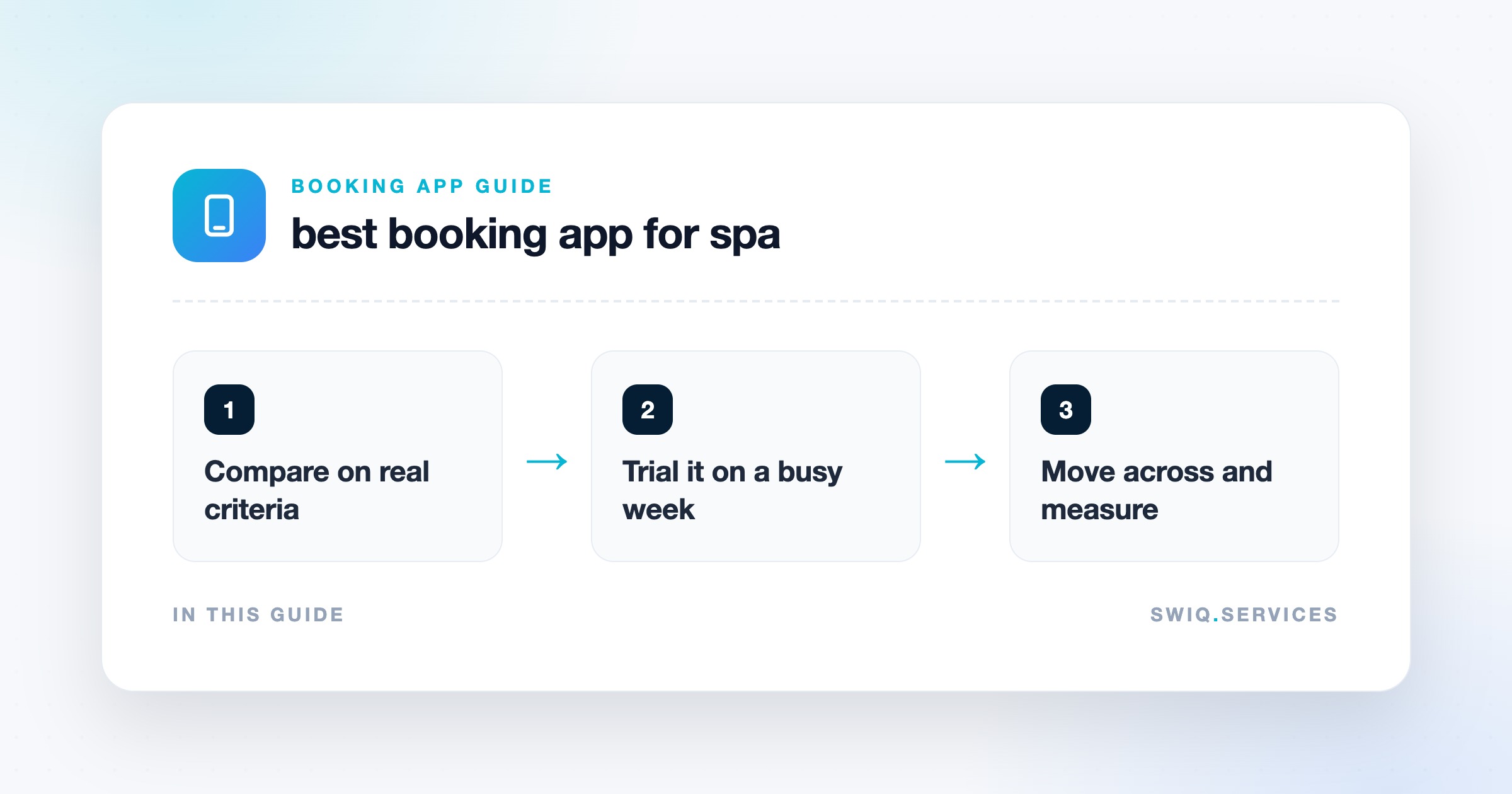
A Step-by-Step Approach
- Create services first, with real durations, buffers and staff assignments attached.
- Enter working hours, breaks and days off for every person who takes bookings.
- Configure slot rules: minimum notice, maximum advance window and daily caps.
- Turn on confirmations and reminders, then send one to yourself as a test.
- Add deposits or cancellation rules if the policy needs them.
- Invite staff with the right permissions and watch one booking flow end to end.
- Open the calendar to a small group of customers before announcing it widely.
For background reading from an independent source, see Google Search documentation. The sequence above is deliberately conservative: it works whether you are testing one day or rolling across locations, and it produces numbers you can defend in a weekly review.
Common Mistakes and How to Avoid Them
Most failures in this area are unglamorous: a setting nobody checked, a message nobody tested, a policy nobody wrote down. The pattern below covers what teams hit first — and the fix for each is usually cheaper than the workaround people live with.
- Copying a feature list instead of testing a real busy Saturday.
- Leaving service durations optimistic, which quietly makes every later slot run late.
- Forgetting buffers, so cleanup time lands on the next customer.
- Sending confirmations from an address nobody monitors when replies arrive.
- Giving everyone admin access, then losing track of who changed what.
- Never exporting data, which turns a trial into a hostage situation.
None of these are dramatic, which is why they survive contact with a busy week. Assign each one an owner this month: the cost of fixing a setting is trivial compared with the cost of living with it for a year.
Features That Matter After the First Week
Week one is demos; week four is enforcement. Check what happens when two customers reach for the last slot, whether buffers survive an edit, if time-off blocks bookings automatically and how the calendar behaves when a service is paused. These are the moments that decide whether staff trust the tool or route around it.
Also look at the unglamorous surfaces: the staff view on a phone, the permission model, the audit trail and how fast support answers when the calendar is wrong during a rush. A platform that is pleasant for the customer and hostile to the team gets shadow-managed in spreadsheets within a month — at which point you are maintaining two systems instead of one.
- Double-booking physically impossible under any input.
- Buffers and time-off respected without manual edits.
- Reminders and reschedules handled without staff action.
- Export available before you commit real customer data.
Practical Tips for a Smoother Experience
Small habits compound. None of the tips below take more than a minute, and together they remove most of the friction people associate with this process.
- Save the booking link somewhere you will find it in ten seconds flat.
- Put your own reminder in the calendar the evening before, not just theirs.
- Ask for the reschedule link before you need it — and test it once.
- Check the last month of reviews and skip the ones with no detail.
- Keep confirmations in one thread so nothing gets buried under newsletters.
- Confirm what the trial week exposed, not the demo before you commit to the slot.
- Leave an honest review after the visit — it sharpens your next shortlist.
- Rebook before you leave if the rhythm is monthly or seasonal.
Conclusion
Done well, best booking app for spa stops being a source of friction ' and starts being a quiet advantage: fewer surprises, shorter waits ' and customers who arrive knowing what to expect. Start with the one ' change that removes the most waiting this week, measure it against ' 'your baseline, and expand from there — momentum matters more ' 'than a perfect plan. For appointment booking and queue management ' 'built for busy service teams, explore ' 'queue management and booking ' 'software from SWIQ or ' 'book a free ' 'demo.
Practical next step: pick the one change from this guide that removes the most waiting, and put it in this week’s calendar before the day fills up.
Related SWIQ pages: queue management software · Book a free demo · Salon Booking System · Clinic Booking System · Best Booking App · Appointment Scheduling Software For Small Business
Frequently asked questions
How do I choose Best Booking App For Spa wisely?
At minimum: real availability from staff hours, impossible double-booking, buffers and time-off respected, confirmations on a channel customers read, a one-tap reschedule path and an export for your data. Test each one against a real busy day rather than a demo script, and keep anything that fails out of the final shortlist.
What should I have ready before I start?
Your real weekly booking volume, the services you offer, staff hours and who will maintain the calendar. Decide deposits, cancellations and confirmation channels before comparing tools. Write it on one page first: decisions made against a list take minutes, decisions made against a feature grid take weeks.
How long does it usually take to set everything up?
For most teams it is an afternoon, not a project: an hour to configure, an hour to test the full path from a phone and a week of watching before you widen. The part that takes longest is agreeing on decisions — hours, deposits and wording — which is exactly why they come first.
What usually goes wrong in the first few weeks?
The unglamorous things: a setting nobody checked, a message nobody tested, a policy nobody wrote down. Expect one surprise in week one, fix it in the open with the team, and review the numbers weekly. Most of what looks like a tool problem turns out to be a configuration or briefing gap.
See SWIQ in action
Reduce wait times and improve front-of-house operations with SWIQ queue management.
Book a free demo