Every morning across India, thousands of patients arrive at hospital OPD counters before opening time just to secure a paper token. They queue at the counter, get a numbered slip, then sit in a crowded waiting room for 1–4 hours with no idea when the doctor will see them. A digital OPD token system in India changes this entirely — giving every patient a mobile queue number they can track from anywhere.
Key takeaways
- Digital OPD tokens eliminate paper slip distribution and crowded front-desk queues.
- Patients track their live token position from their phone — no waiting room required until they're close to their turn.
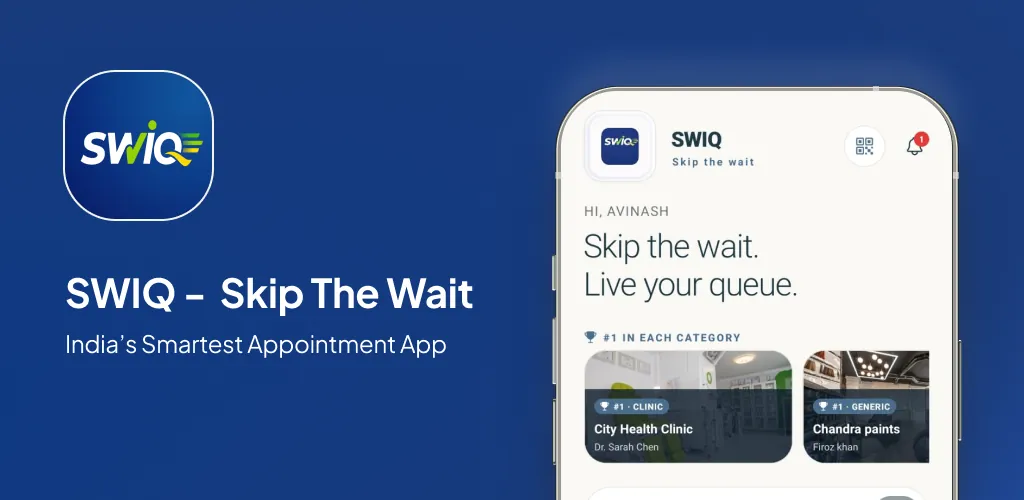
- SWIQ integrates online booking, walk-in token registration, and live queue tracking in one system.
- No hardware required — works on any smartphone or tablet for both staff and patients.
The problem with paper OPD token slips in India
India's hospital OPD departments — both government and private — still rely heavily on paper token slips. The problems are well-documented:
- Crowded front desk: Hundreds of patients crowd the registration counter before OPD opens, creating safety and hygiene risks.
- No visibility: After receiving Token 47, patients have no way to know if the doctor is on Token 20 or Token 45. They sit and wait.
- Wasted time: A patient with Token 80 may spend 3 hours waiting when they only needed to arrive 40 minutes before their turn.
- No notifications: Patients who step away miss their token being called and lose their slot.
- Manual reconciliation: Paper tokens create reconciliation nightmares for hospital billing, attendance, and audit.
Digital OPD token systems solve all five problems simultaneously.
How a digital OPD token system works
The SWIQ digital OPD token system operates in two modes depending on the hospital's setup:
Mode 1: Online pre-booking
Patients book a specific OPD slot online (via SWIQ app, QR code, or booking link) before visiting. They receive a digital token (e.g., OPD-A-07) along with the date, time, and doctor details. On the day of the appointment, they track their position from their phone and arrive when they are 2–3 tokens away.
Mode 2: Walk-in token registration
The front desk receptionist registers walk-in patients using the SWIQ staff dashboard. The patient receives a token via SMS or by scanning a QR code on their phone. From that point, they can track their position from the waiting area or the hospital canteen — without standing at the counter.
Both modes update the same live queue, so the doctor's dashboard always reflects the current state of the OPD regardless of how the patient entered the system.
Key features of a digital OPD queue management system
- Unique digital token per patient — scannable QR code or numeric token ID
- Live queue position — updates in real time as the doctor calls tokens
- Delay clock — shows how far the doctor is behind schedule in minutes
- Automated push notifications — "You are next", "Doctor ready in 10 min"
- Multi-doctor queues — each doctor in the OPD has a separate live queue
- Staff call-next controls — the receptionist advances the queue from a tablet or phone
- Walk-in and pre-booked in same queue — handled fairly by arrival order or booking priority
- OPD analytics — daily patient count, average wait, tokens served per shift
Live tracking from home — why it matters for Indian patients
For a senior citizen living 20 km from the hospital, arriving 2 hours early to secure a token wastes half a day. With a digital OPD token system, the same patient books a slot the previous evening, receives Token OPD-45, and tracks the queue from home. When the system shows Token OPD-40 is being served, they leave home — arriving at the hospital close to their actual turn.
This is particularly important in Indian hospitals where:
- Patients travel long distances from rural areas.
- Elderly and mobility-impaired patients cannot stand in long queues.
- Hospital waiting rooms are often over capacity, creating health risks (especially post-COVID).
- Patients accompanying elderly relatives miss work hours sitting in waiting rooms.
Walk-in token integration at the OPD counter
Not all patients pre-book. SWIQ handles walk-ins without disrupting the pre-booked queue:
- The receptionist taps "Add Walk-in" in the staff dashboard.
- The system assigns the next available token in the current shift.
- The patient receives their digital token via the waiting room QR code or SMS.
- Walk-in tokens interleave with pre-booked tokens based on the hospital's priority rules (e.g., pre-booked patients always take priority, or first-come-first-served for both).
UPI advance booking fees for OPD slots
For private hospitals and diagnostic centres that charge OPD consultation fees, SWIQ integrates UPI advance payment directly into the slot booking flow. Patients pay the consultation fee at the time of booking — eliminating cash queues at the hospital billing counter on the day of the visit.
Government hospitals and public health centres can use SWIQ in token-only mode without any payment collection, keeping the system fully free for patients.
Implementing a digital OPD token system — step by step
- Create a SWIQ provider account for the hospital or OPD department.
- Add OPD services — define each doctor as a separate service (e.g., "OPD — Dr. Sharma", "OPD — Pediatrics").
- Configure OPD shifts — morning (8am–1pm), evening (3pm–7pm), or custom hours.
- Set slot capacity — e.g., 4 patients per 30 minutes for a busy OPD.
- Print QR codes for the front desk, waiting area, and hospital gate.
- Train reception staff on the SWIQ staff dashboard — 15 minutes is typically sufficient.
- Go live — patients scan QR codes, book slots or receive walk-in tokens, and track from their phones.
Digital OPD token systems for government and private hospitals
Government hospitals
Government OPD departments can implement SWIQ in walk-in-only mode for free (up to 50 tokens/day on the Starter plan). Patients receive free digital tokens without any app download — just a QR code scan. This is particularly effective for district hospitals and primary health centres looking to reduce front-desk crowding.
Private hospitals
Private hospitals can implement the full SWIQ OPD token system with online booking, UPI advance fees, multi-doctor queues, and analytics. The Pro plan at ₹1,777/month supports up to 10,000 OPD tokens monthly — sufficient for a 200-bed private hospital.
Start with a free OPD pilot: set up one doctor's queue on SWIQ this week. No hardware, no IT team, no per-patient cost.
Official resource
For digital health standards in India's public health system, see the Ayushman Bharat Digital Mission (ABDM) — India's framework for interoperable health data and patient records.
Frequently asked questions
What is a digital OPD token system in India?
A digital OPD token system replaces paper token slips with a mobile-based queue number. Patients book a slot via app or QR code, receive a digital token, and track their position in real time on their phone.
How does a digital OPD token system reduce patient waiting time?
By showing live queue position and estimated wait time, patients can arrive at the hospital closer to their actual turn — eliminating the 1–3 hours spent sitting in the waiting room before their slot even opens.
Can SWIQ be used as an OPD token system for Indian hospitals?
Yes. SWIQ supports OPD-style appointment booking with exact time slots, live token tracking, walk-in queue integration, and a staff dashboard for calling tokens. It works for both public-facing bookings and front-desk walk-in registration.
Is a digital OPD token system expensive to implement?
SWIQ starts free (50 slots/month) and costs ₹777/month for up to 3,000 bookings. There is no hardware required — the system runs on any smartphone or tablet.
Can patients track their OPD token status from home?
Yes. SWIQ's live queue tracking allows patients to see their token position from any device. Automated notifications alert them when they are next in line so they can time their hospital arrival.
Launch your digital OPD token system today
Replace paper token slips with a mobile-first queue. Free to start, no hardware needed.
Get Started Free →